Connecting Stories Together in a Book

5 thought on “Connecting Stories Together in a Book”
Comments are closed.
Related Post
Creating a Legacy Family History BookCreating a Legacy Family History Book
It’s time to stop procrastinating and start pulling your research into a family history book. Is the thought a little overwhelming? Not sure where to start?
Here at The Family History Writing Studio, we believe in helping you preserve your family history in a sharable and entertaining format. We want your family history book to be a book your family wants to read and pass down for generations to come.
It’s time to stop procrastinating and start pulling your research into a family history book. Is the thought a little overwhelming? Not sure where to start? We are here to help.
We have a brand new course starting in just a few weeks. We are excited to be delivering Creating a Legacy Family History Book. Take a look at our video, it’s just 6 minutes long and we’ll take you inside a Legacy Family History Book created with the MyCanvas software.
Your book could look like this! Watch the video!
Here’s What You’ll Learn
Week 1 – Introductions
- MyCanvas Tour
- Your First Decisions
Week 2 – Getting Ready to Build and Write
- Importing Files from Ancestry and Beyond
- Creating a Workflow
Week 3 – Handling Pictures and Documents
- Prepping Your Pictures and Documents
- Copyright and Permissions
Week 4 – Structuring Your Book and Stories
- Structuring Your Book
- Structuring Your Stories
Week 5 – Assembling a Page
- Basics of Assembling a Page
- Creating a Story Framework
Week 6 – More Pages, More Writing
- Creating a Variety of Pages
- Bringing Your Ancestors to Life on the Page
Week 7 – Polishing Your Book
- Revision and Editing
Week 8 – Final Product, Now What?
- Ordering Your Book
- Recap and Final Questions
[button url=”https://www.familyhistorywritingstudio.com/product/creating-a-legacy-family-history-book/” class=”yellow” bg=”” hover_bg=”” size=”0px” color=”” radius=”0px” width=”0px” height=”0px” target=”_self”] I Want To Build a Legacy Family History Book [/button]
How the Class Works
Each week you will have access to one or two videos, each helping you to understand how to build a book using the MyCanvas software but also you’ll learn about structuring your book and your stories. We won’t just talk about the book we will talk about the skills you’ll need to write entertaining stories.
You can download the videos each week and watch them when they are convenient to you. If you have any questions over the course of the 8 weeks you’ll have to two teachers in the forum to help you with your project.
The homework is completely optional but we hope you’ll complete the homework so that we can help you with any questions you may have along the way.
Here are a few comments from some students who have already taken some of our classes, so you can be sure we will deliver quality and value for your money.
What Students Have Said about The Family History Writing Studio
Kim Said:
I thoroughly enjoyed completing this course in “Writing a Family History Scene” and would recommend it to all aspiring family history writers. It is inspiring when you can see yourself and your fellow students improve so much by the end of the course. Lynn’s teachings have given us the tools to carefully craft our stories for the enjoyment by our families. I have learned so much.
Denise Said:
This course opened my eyes to scene structure. My writing improved immensely once I had the right tools and guidance to build a scene properly. This is my second Family History Writing Studio course, and it will not be my last. Between Lynn’s excellent guidance and the input from the other students, it was an interactive learning experience I highly recommend to anyone who is thinking of writing a family history narrative. In order to do any job properly, you need the right tools and, in my opinion, this is the place to build your toolbox.
[button url=”https://www.familyhistorywritingstudio.com/product/creating-a-legacy-family-history-book/” class=”red” bg=”” hover_bg=”” size=”0px” color=”” radius=”0px” width=”0px” height=”0px” target=”_self”] I Want To Build a Legacy Family History Book [/button]
Now that we’ve answered all your questions click the link, add the course to the shopping cart and checkout. After checkout, you’ll receive an email welcoming you to the class. Closer to the date of the first class you’ll receive and email and some instruction for finding your way around the website and getting acquainted with the forum.
We look forward to seeing you in the classroom.[/vc_column_text][/vc_column][/vc_row]

Top 10 Ingredients to Building an Heirloom Family History BookTop 10 Ingredients to Building an Heirloom Family History Book
One.
Stories – Your stories can come in a variety of forms. They may be a collection narrative nonfiction short stories about a variety of ancestors. You may choose to write a longer form story taking the reader through an epic adventure based on one ancestor, a couple or a surname line. 
Two.
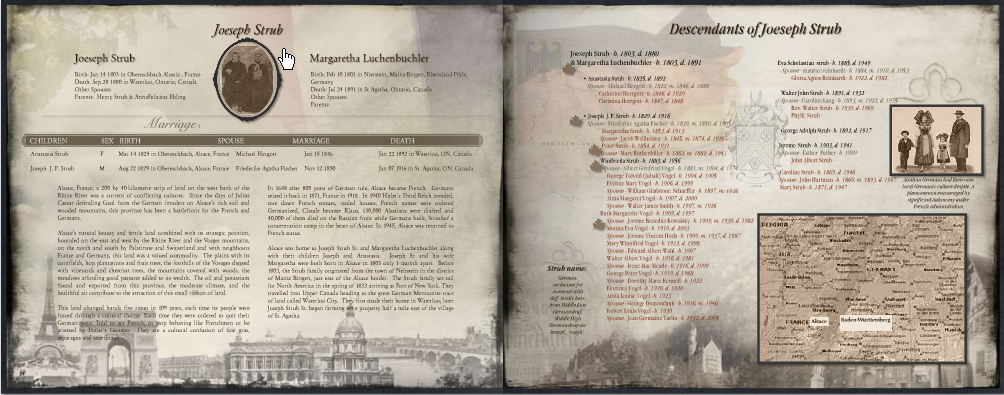
Profiles – You can include ancestor profiles in your book to give your reader a snapshot look into an ancestor. Use profiles when you have too many gaps in your research to tell their whole story. If the ancestor has a great story, they are an interesting person, but they are not directly part of your main narrative consider writing a profile in the sidebar or give them a single on off page. This page is dedicated to a great-uncle who died at Passchendaele in WWI. He wasn’t directly part of the story, but we felt the need to honour him.
Three.
Pedigree Charts – Pedigree charts can serve the readers as a beautiful big picture view of their family history. If you are covering several surname lines in a book, consider including one for each.
Four.
Group Sheets –Each time you start a new family, a group sheet a is a great way to give the reader a big picture view. You can also include some smaller details and facts on the group sheets. By making sure all these details are on the group sheet, you won’t feel required to cram it all into the story. The story can then be a story and not a collections of facts woven together.
Five.
Descendants Chart – The descendant’s chart can help you to include the children of a couple, along with their spouses and children. This conveys a lot of information that may not be part of the direct line you are writing about but still expresses your research and can be an excellent resource for the family.
Six.
Pictures – Choose pictures that enhance your story and show your ancestors in various stages of their life. Unfortunately, not everyone will take the time to read the stories. Sigh.
Seven.
Picture Collage – Consider creating a picture collage, it can demonstrate a life without words.
Eight.
Documents – Choose poignant documents that reveal essential turning points in your ancestor’s life. Passenger lists, land document, will. Don’t feel obligated to include every census and vital record you have uncovered only the ones that were critical to the direction of your family history. If you wish to share the rest of your research and documents, save them to a cd and insert in the back of your book.
Nine.
Sources – Don’t forget to include your sources. While footnotes may not be ideal for an Heirloom Family History Book, you can still add a list of sources at the end of your book referencing the page numbers and quote the line of the fact. You can also add your list of sources to the cd if you want to keep a clean look to your heirloom book.
Ten.
Current Family – Don’t forget to include your present family in your book. If they are in it and they can see their connection to the past they are more likely to take up interest and buy your book.

Hey Lynn…Great suggestion. Thanks!
I like that suggestion, Lynn,
Each ancestor’s story taking place in their own part of the book, as a separate story.
My book will be in two parts, but with the same ancestor. Part One: His life before immigration, and why he immigrated. Part Two: Immigration and dealing with a new set of problems.
Thanks for your valued wisdom and advice.
Have a wonderful Easter weekend.
Love and blessings, Paula.
Thank you Lynn for addressing my question.
I like your idea of writing three separate stories with just a small introduction of the next generation within each one. A little glimpse into the life of the son; a hint of what is to come if the reader presses on through the story.
I also love your idea of writing the individual stories as sequels. Perhaps that’s where I can draw a connection to the theme again; from the end of one story to the beginning of another.
Thanks again Lynn. Your advice is helpful in sorting some things out in my head! Brenda
Your suggestion is very useful, thanks Lynn.
I have a further complication that you can perhaps comment on.
I’m writing about my grandfather: he fought in WW1, married , lost his wife, remarried and went through WW2.
I’m also writing his wife’s story: she was an artist, she married, she died after giving birth.
So both have lives before marrying, both undergo the tragedy of her death, and he lives on afterwards in another life.
Two stories which come together in the middle.
How can I best connect these stories?
Your suggestion is very useful, thanks Lynn.
I have a further complication that you can perhaps comment on.
I’m writing about my grandfather: he fought in WW1, married , lost his wife, remarried and went through WW2.
I’m also writing his wife’s story: she was an artist, she married, she died after giving birth.
So both have lives before marrying, both undergo the tragedy of her death, and he lives on afterwards in another life.
Two stories which come together in the middle.
How can I best connect these stories?