In just 15 minutes a day over 5 days you could write a small family story scene that could be shared in some interesting ways over the holiday season. Watch to learn how than click here to download your free resource to help you.
How to Share Family Stories during the Holidays
4 thought on “How to Share Family Stories during the Holidays”
Comments are closed.
Related Post

Make Your Scenes Pop!Make Your Scenes Pop!
Do your stories pop?
Do they engage your reader and give them a vision in their mind through the words you’ve strung together on the page. As writers, our goal is to create clear and detailed images through the use of descriptive language. If you’re not using descriptive writing in your family history stories then you are missing an opportunity to show rather than tell. Descriptive writing adds texture, colour and dimension to our stories. It is how we make reading a sensory experience for our readers.
My favourite quote that helps to illustrate showing in scenes remains:
“DON’T TELL ME THE MOON IS SHINING; SHOW ME THE GLINT OF LIGHT ON BROKEN GLASS.”
ANTON CHEKHOV
As we discussed in How to Write a Scene, detailed description, imagery and figurative language are components of a scene that we heavily rely on to make a scene vivid and in full colour for the reader. Today’s post pulls together a few tips to help you improve your use of description in writing your scenes.
Use all of your senses.
As we mentioned in How to Write a Scene using your senses is an essential ingredient of descriptive writing. Using the senses of touch, taste, hearing, seeing and smelling are all equally important in bringing your ancestor’s experience to life on the page. We often tend only to use sight, but employing a combination of senses gives your reader a much deeper experience.
Avoid Clichés
Clichés are words or expressions that have been overused. They may have been original at one time but through overuse they have become clichés. Be aware of them and find fresh and original ways to describe your story. Some examples of clichés include dead as a doornail, smart as a whip, sweet as sugar. You get the idea.
Use a Thesaurus
Try to avoid using the same words in a sentence, paragraph or, if it is an uncommon word, in the story, unless the word is used for effect. This applies to standard words and less common words. Use a thesaurus to find alternative words that convey the same meaning. (I used the word “word” eight times – did you notice?)
Use Personification, Similes, and Metaphors
Personifications, similes, and metaphors can add sensuous references vividly, explain things, express emotion and entertain your reader. They add richness to your writing and show an image in a vibrant way through example rather than tell directly. They should replace, enhance or define adjectives like, beautiful, sweet, picturesque and others. We’ve all learned about similes and metaphors in school. Perhaps, it’s time for a refresher course, and a little practice to help you see just how important it can be in writing your family history stories.
Let’s take a look at each with examples from the memoir Glass Castle by Jeannette Walls.
Personification
Personification adds human personality traits to inanimate objects.
“Finally, we entered hill country, climbing higher and deeper into the Appalachian Mountains, stopping from time to time to let the Oldsmobile catch its breath.”
Simile
A simile ties two things together using the words ‘as’ or ‘like.’
“ It was like sewing meat. It was sewing meat.” Mr. Walls gets beat up and asks for Jeannette to sew up a gash on his arm.
Metaphor
Metaphors are figurative comparisons that describe one thing by directly assigning it the traits of another, so one idea is understood in terms of the other.
Rex says Maureen “is a sick puppy, the runt of the litter, who should have been drowned at birth”
This statement expresses how Rex feels Maureen is weak and dependent, and the rest of the family has to provide for her.
Don’t Over Do it!
Beginning writers tend to lack confidence in writing description in those early days, but once they gain an understanding of description, they can then go too far and overdo it. As I mentioned in writing a scene, too much detail can completely overtake a story and it bears repeating again. Once we get the handle on description and detail we tend to find a reason to think more is better. It is not. As the artist of this work you must make decisions about which descriptions and details serve the story best, the feeling you want to portray on the page. Description should enhance your characters and their world, not overwhelm it.
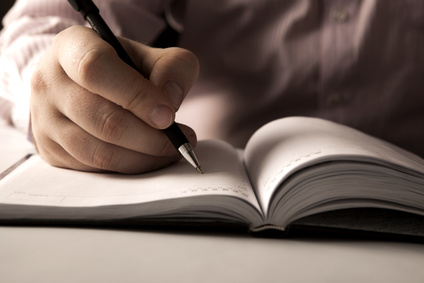
The Writer’s NotebookThe Writer’s Notebook
The writer’s notebook, it’s not a diary or a journal but a valuable tool to help you develop your writing skills. It’s a place to be a writer.
A writer’s notebook can help you develop your writing skills through a variety of ways.
- A writer’s notebook will help you to pay attention to the world around you. By recording events, ideas, dialogue, people that you come across in your day, you become more aware of your surroundings, the setting, how people interact. In your notebook capture what moves you in the day. Perhaps it was a conversation you overheard, or person you saw, or something in nature that caught your attention. Write it down, explore what it means to you. Practice transforming what you see, hear, smell, touch, and taste during your day in to words on the page.
- A writer’s notebook will help you develop ideas. Your book is a place to capture seed ideas. Whether they are ideas for stories or scenes or even if you’re not sure what you plan to do with them. It’s a place to nurture ideas, keep them safe until you’ve ready to explore them further.
- A writer’s notebook can help you develop your creative writing skills. Practice scene writing, dialogue and descriptive writing. Heard a conversation, recreate it in words on the page, what did they say, how did they say it. It can teach you to listen. It can teach you to be aware to details.
- A writer’s notebook can help you to expand your vocabulary. Record favourite words, unusual words you hear in your day, or a new word you’ve recently learned.
- A writer’s notebook is a place to explore your memories bring them out of your head and onto the page.
- A writer’s notebook is a place to map a story, draw a plot line, sketch a setting, or draw a character, maybe an ancestor?
Spend 10-15 minutes a day free writing in your writer’s notebook. Carry it with you throughout the day. It will help you to develop your voice and your sense of self as a writer.
Don’t restrict your entries to family history thoughts and ideas. Our ancestors lived in the real world. They interacted with the world around them. Observing your world today can help you add tremendous detail to your stories and help you to learn the tools of character, setting, dialogue and description enhancing your creative writing skills.
Here are a few prompts to help you get your notebook started.
- A gesture, word or phrase you found interesting
- A conversation you overheard
- An interesting person who you met or observed
- A person from your past, you want to remember
- A description of a photograph
- What you see outside the window
- Surroundings you may have passed in your daily travels
- A quote you heard today
- A dish or meal that you made or ate, note its characteristics using all your senses or just one.
One thing is certain, to become a better writer; you must be an observer of the world and you must practice writing. Starting a writer’s notebook is an opportunity to incorporate both into your daily routine.
Thank you Lynn for your terrific ideas!!! Since many of our large family of kids, grandkids and great grandkids will be together during Christmas, I am going to make place setting memories of their ancestors. So excited to share this way!! Thanks again
I love your idea of adding family history stories to holiday cards. This is so do-able.
I put in my information but I could not download the guide.
I like to make some of my mother’s traditional dishes during the holidays. I copy the recipe
and talk about it during dinner. Family story about “Mom’s Fruitcake”. Mom always made her fruitcakes after receiving whole pecans and walnuts from our Aunt Lucy, who lived in Louisiana. They were made two weeks before Thanksgiving.