How to Strengthen the Inner Conflict
Related Post

Starting at the EndStarting at the End
All stories must end in a different place from where they began.
Family history stories are no different. They are not obligated to stop at the conclusion of a life, or with a happily ever after. They end when your ancestor has achieved something in their life that has brought about change and growth, hopefully, both internally and externally.
As we’ve discussed earlier on in this month, stories are about conflict, a complication. We’ve looked at identifying that conflict and how our ancestors have overcome obstacles on their path to their goal.
The third act of our story focuses on the climax and the resolution. The climax being that final conflict that will ultimately resolve your ancestor’s problem and bring about a resolution. The resolution is the point in your ancestor’s life when they achieve what they set out accomplish, whether that is to own land or emigrate or acquire a prominent position or be free, etc. The resolution is the prize, the reward at the end of the journey.
For some family history writers, this may be very clear and apparent at the start. However, some of you may be struggling to find that resolution, to identify your plot line from the conflict to a resolution, to identify the prize in your ancestor’s journey. This may be presenting a problem because not all conflicts in a person’s life have resolutions. Perhaps you’ve chosen a conflict with no clear resolution.Therefore, you may have better luck in developing a strong story line by identifying the resolution first and working backwards.
Identifying the Resolution
Look at your ancestor’s life as a whole, make a list of the achievements they accomplished in their life. Consider the following questions.
- How big is the success? The bigger the success, the more significant the efforts, the more powerful the story.
- Remember anything your ancestor does on purpose will most definitely have a motivation behind it, for example, your ancestor receives a diploma, acquires land, obtains a prominent position, sets sail for a new land, becomes a military officer. These are all goals that require purposeful action on their part, pressed upon by some motivation. What motivated the action to the accomplishment?
- There is often complications on the road to the accomplishment. Did the accomplishment come through way of a struggle?
- Did the resolution/accomplishment grow out of your ancestor’s own actions?
Keeping the above thoughts in mind choose an achievement/resolution that you feel meets the above criteria.
Linking the Resolution to the Conflict
Once you identify the resolution and the conflict in your ancestor’s life, linked them together. Look for the actionable steps your ancestor took working back from the resolution to the conflict. Each of these actionable events are the obstacles. These are events in which your ancestor either does something or something is done to him in pursuit of the achievement. Identify those and you’ve identified the obstacles he overcame on his path. Connect your resolution through these obstacles to the initial conflict. You’ve just identified the plot of your story from the end to the beginning.
If you’re struggling to find the end of your story perhaps it’s because your conflict doesn’t have a resolution. If your struggling to find your storyline then look to your ancestor’s achievements in their life and work backwards.
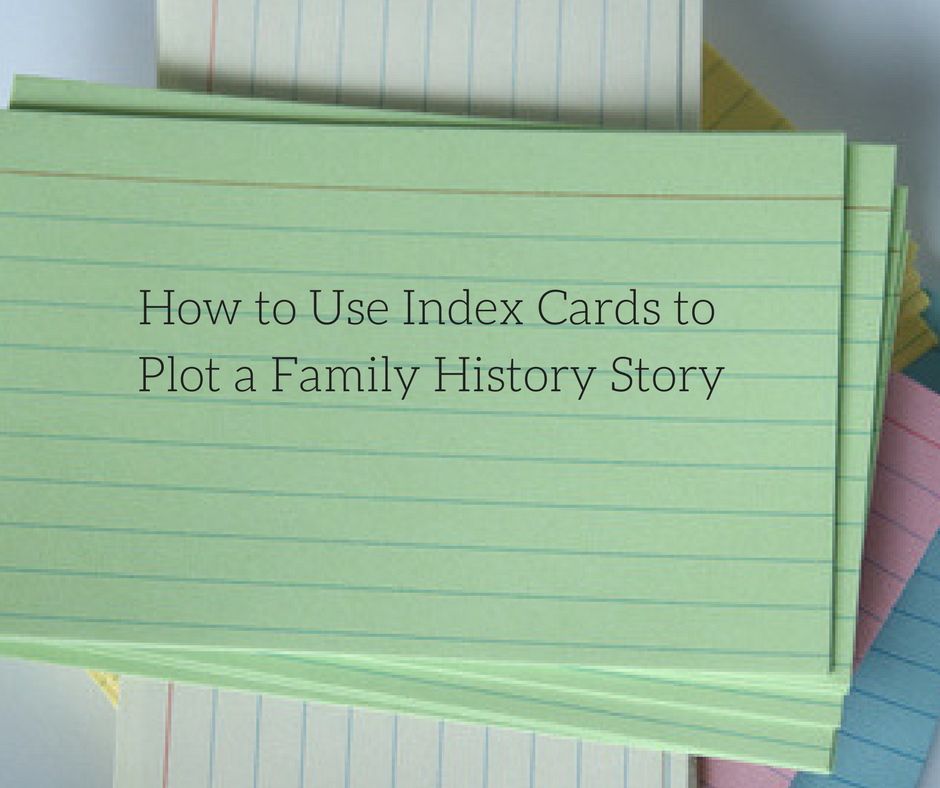
How to Use Index Cards to Plot a Family HistoryHow to Use Index Cards to Plot a Family History
I’m known as a plotter. This means I love to outline my stories in great detail before I begin to write. For me, it’s like creating a road map of a story from start to finish. It allows me to organize my story so that when I start to write I know exactly what I’m writing and where I’m going with the story. It eliminates sitting and staring at my computer screen in that deep dark hole known as writer’s block.
I use index cards to create this map. Each index card represents a scene or a summary. A creative nonfiction story is comprised of scenes and summaries and having those scenes carefully thought out in advance can help keep you organized and writing every day. Check out my scene building cards that I designed just for family history writers.
Once I have my story mapped out with my index cards, then I can begin to write my first draft.
While index cards may seem a rather old-fashioned method for outlining it is with good reason it’s still around, it works. Of course, just as technology has impressed itself on every aspect of our lives even the little old index card has not gone untouched by the digital world. You can still use paper index cards if you are tactile, and like the physical feel of a paper card in front of you. I love to lay out my index cards on a corkboard in my office it keeps my story in front of me and top of mind.
There are plenty of digital index cards available today that have replaced the paper card. For instance, Scrivener offers index cards on a corkboard so that you can storyboard your family history within the writing program. Check out this video to see how to use the Scrivener corkboard. Scrivener also offers the ability to print off those cards so you can still have those paper cards to shuffle around on a physical corkboard.
There are plenty of apps for index cards, the Corkboard Writing app, and the Index Card app are just a couple. Most are available for iPads and iPhones. Check the Apple App store for a selection.
Elements of an Index Card
An index card will record either a scene or a summary on the card. On each card, you will record bullet points to help you write that particular scene or summary. Here is an article that explains the difference between scene and summary.
Scene cards should contain a few basic elements that will help you to write the scene when it comes time to put pen to paper.
Who – the primary ancestor in the scene
Scene Goal – your ancestor hopes to accomplish an explicit goal with the scene. Read here about scene goals.
Action – what physically happens in the scene.
Setting – Where and when does it happen? Indoors? Outdoors? Time of year, day, place, etc.
Conflict – within the scene is conflict, tension or suspense.
Inner Journey– how is your ancestor emotionally affected by the outer journey or action happening in the scene.
Theme – Do the details in the scene support the theme you have created?
Index cards are another tool in our writer’s toolbox that helps us to break down our writing into manageable tasks, keeping us from becoming overwhelmed and hitting that all too familiar writer’s block.
Want to learn more about how to write to write a family history scene consider our upcoming class, Writing a Family History Scene.
To understand how to format a story using scene cards, consider joining us for our upcoming course Plotting a Family History Story or our e-workbook, Finding the Story. Also available on Amazon in paperback.